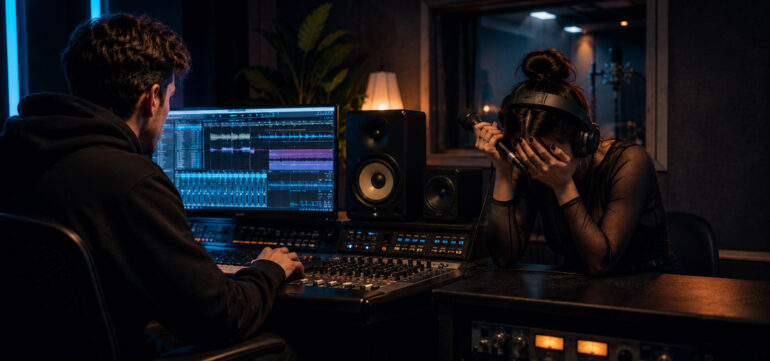
As algorithms shape what we hear, when we hear it, and how we find it, something is quietly being lost: taste. In an era of infinite access and automated recommendations, the role of the curator—someone with vision, voice, and gut instinct—has never been more critical. Especially in electronic music, where discovery used to be half the thrill, the feed is flattening everything into the same beige blur. This is a call to bring curation back to the front of the stage.
The Beige Wave
Open your favorite playlist. Hit shuffle. Feel anything?
Didn’t think so.
Somewhere along the way, the pulse of discovery started to flatline. The colors dulled. The edges got sanded down. And what used to feel like an adventure—digging through crates, chasing IDs, stumbling onto that one track that cracked your whole world open—has been replaced with an infinite scroll of sameness.
This isn’t just a vibe shift. It’s a symptom.
The algorithm is in control.
This creeping sameness has a name—The Beige Wave.
It’s not a genre. It’s not a trend. It’s what happens when music is filtered, flattened, and optimized to offend no one. Everything sounds fine. Polished. Playable. But nothing grabs you.
It’s music made for metrics—not for movement.
Sure, it’s convenient. You get a steady drip of songs that sound like songs you already like. But over time, that convenience comes at a cost. You start mistaking comfort for taste. You stop noticing the difference between good and just good enough.
In a scene like electronic music—where sound is supposed to evolve, where culture has always been driven by curiosity and risk—this flattening is dangerous.
We didn’t come here for background music.
We came here to feel something.
That’s why, now more than ever, we need curators. Not just DJs. Not just playlists. But authentic, opinionated, taste-driven voices who dare to lead—who challenge the feed and disrupt the drift.
Because the truth is simple:
The algorithm has no taste. But we still can.
Algorithms vs. Taste
Let’s be clear: algorithms aren’t evil.
They’re just math.
At their best, they help surface songs you might’ve missed. They make discovery easier—on the surface, anyway. But what they’re really doing is feeding you patterns. Repetition. Similarities. Slight variations of what you already engage with.
That’s not discovery. That’s duplication.
Most major platforms (Spotify, YouTube, Apple Music) rely on collaborative filtering. You like Track A? And so do 10,000 other people who also like Track B? Congrats—you’re about to get a neat little loop of both. Over and over. That’s how the system works.
But taste doesn’t work like that.
Taste is irrational. It’s emotional. It’s shaped by time, place, context, and contradiction. Taste says, “I don’t know why this works—but it does.” The algorithm says, “This is statistically adjacent to your last choice.”
That’s a critical gap in a genre built on feeling. Electronic music doesn’t just reward innovation—it requires it. It’s a soundscape shaped by emotion, instinct, and unexpected moments. When discovery becomes predictable, the heart of the genre gets muted.
Electronic music thrives when someone takes a left turn—when a producer flips the script, when a DJ throws something jarring into the mix, when a tastemaker bets on a track that hasn’t charted yet. Algorithms don’t take those kinds of risks. They can’t.
They don’t hear potential.
They just count clicks.
What We’re Losing
When algorithms become the default tastemakers, something essential begins to fade—not just the edge of innovation, but the soul of discovery itself.
We lose context.
We lose narrative.
We lose the human spark that makes a song feel like more than just sound.
An algorithm doesn’t know the difference between a bedroom-produced track that changed someone’s life and a label-funded copycat engineered for playlist placement. It doesn’t care if a song breaks the mold. It only cares if it fits the pattern.
And that means the bold, the weird, the emotional, the left-of-center—those tracks get buried. Because they don’t check the boxes fast enough. They take time to understand. They don’t sound like the last ten things you liked. And that’s the point.
Without curators—without humans who say, “I don’t care what’s trending, this is brilliant”—those moments get lost in the scroll.
We stop getting surprised.
We stop getting challenged.
We stop feeling the rush of finding something before the world catches on.
And maybe worst of all?
We start mistaking the algorithm’s taste for our own.
Remember Tastemakers?
Before the algorithm, there were tastemakers.
People—not platforms—were the ones guiding discovery. They weren’t optimizing for skip rates or release cadence. They were trusting their gut, digging deep, and putting their name behind sounds that hadn’t yet gone mainstream. They weren’t trying to be data-driven—they were trying to move you.
Tastemakers used to be the filter and the force.
A record didn’t need a viral moment—it just needed the right selector to believe in it.
Think back:
- The DJs who played unreleased tracks for weeks before they had titles.
- The music blogs that gave artists their first real exposure, long before DSPs had editorial playlists.
- The SoundCloud accounts, YouTube channels, and pirate radio shows that helped birth entire subgenres.
These curators weren’t asking, “Will this track convert?”
They were saying, “You need to hear this.”
They made music feel like culture—not content.
And while some of those voices have faded or gone corporate, the spirit of curation isn’t dead. It’s just being drowned out by the noise of automation.
But here’s the truth: when a trusted human says this is worth your time, that recommendation still hits different. It carries weight. It carries taste.
And right now, we need more of that.
Why Curation Still Wins in 2025
In a world of infinite music, the most valuable thing isn’t more music.
It’s trust.
When everything is available, what people crave isn’t access—it’s guidance. They want to be shown what matters. They want someone with taste, with context, with a point of view, to say: this one.
That’s why curation still matters—even now. Especially now.
Because playlists without curators are just data sets.
And recommendation engines without emotion are just noise with a nice UI.
Real curation builds something deeper: a relationship.
It turns passive listeners into active fans. It transforms “discovery” from a background task into a front-row experience. And it reminds people that music isn’t just about what’s new—it’s about what’s right for the moment.
You see it in the DJs who craft emotional arcs instead of just stringing bangers together.
You see it in the labels whose aesthetic is so dialed-in that you follow them without even previewing the tracks.
You see it in platforms—like this one—that believe good taste still belongs at the front of the feed.
Because while the algorithm can guess what you’ll like,
the curator tells you what you need.
What the Scene Needs Now
If electronic music is going to keep evolving, it needs leaders—not loops.
It needs labels that stand for something beyond output.
DJs who program sets like stories, not playlists.
Fans who follow curators, not just channels.
Platforms that dare to filter in an era obsessed with volume.
This is a call for intentionality.
Support the mixes, the hand-built playlists, the radio shows, the indie blogs, and the tastemakers who risk something every time they hit play. Don’t just let the algorithm wash over you—swim upstream.
Because the best discoveries aren’t predictable.
They’re personal.
And if we want music that means something, we have to seek out the people who still know how to find it.
Taste Is the New Counterculture
The algorithm doesn’t have favorites.
It doesn’t fall in love.
It doesn’t take risks.
But you do.
And that’s why your taste still matters—maybe more than ever.
Please share and rate this article if it resonated with you